

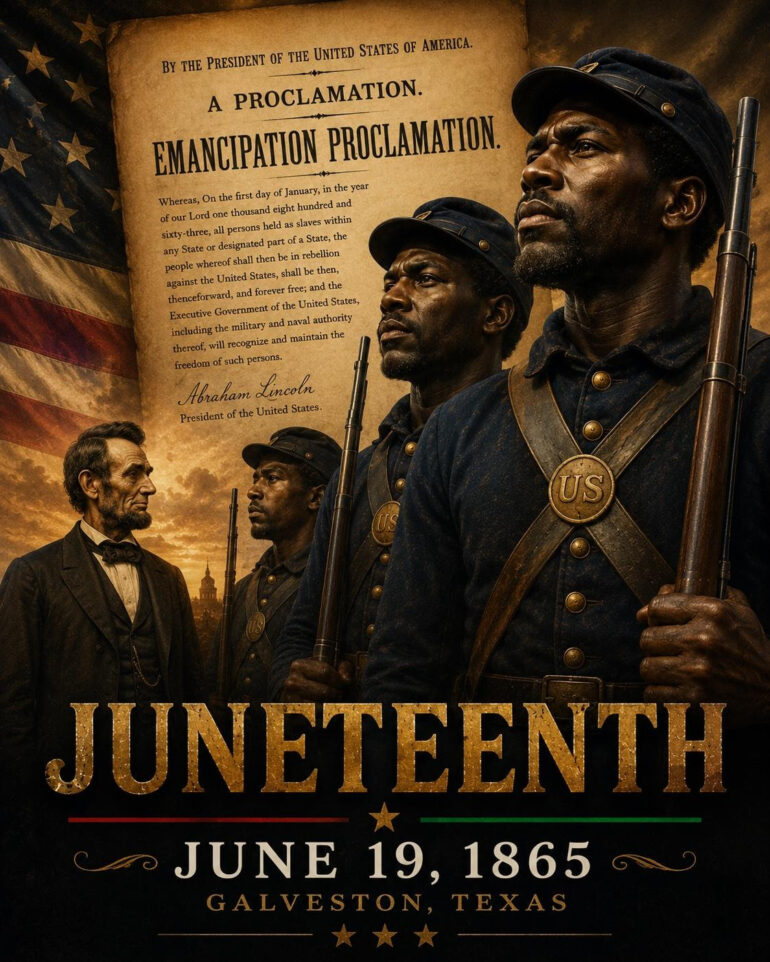
On June 19, 1865, 2,000 Union soldiers, after defeating Confederate soldiers in the Civil War, marched into Galveston, Texas, and informed Black people that they were free men and women. Gen. Gordan Granger announced that the four-year war, fought over slavery, was officially over and as a result of the Emancipation Proclamation, an executive order issued by President Lincoln in 1863, all Black people in the state of Texas and the other 10 former Confederate states were no longer enslaved.
His words were, “The people of Texas are informed that in accordance with a Proclamation from the Executive of the United States, all slaves are free. This involves an absolute equality of rights and rights of property between former masters and slaves, and the connection heretofore existing between them becomes that between employer and free laborer.”
This ended 246 years of Black people’s bondage in America and this date is now a federal holiday called Juneteenth.
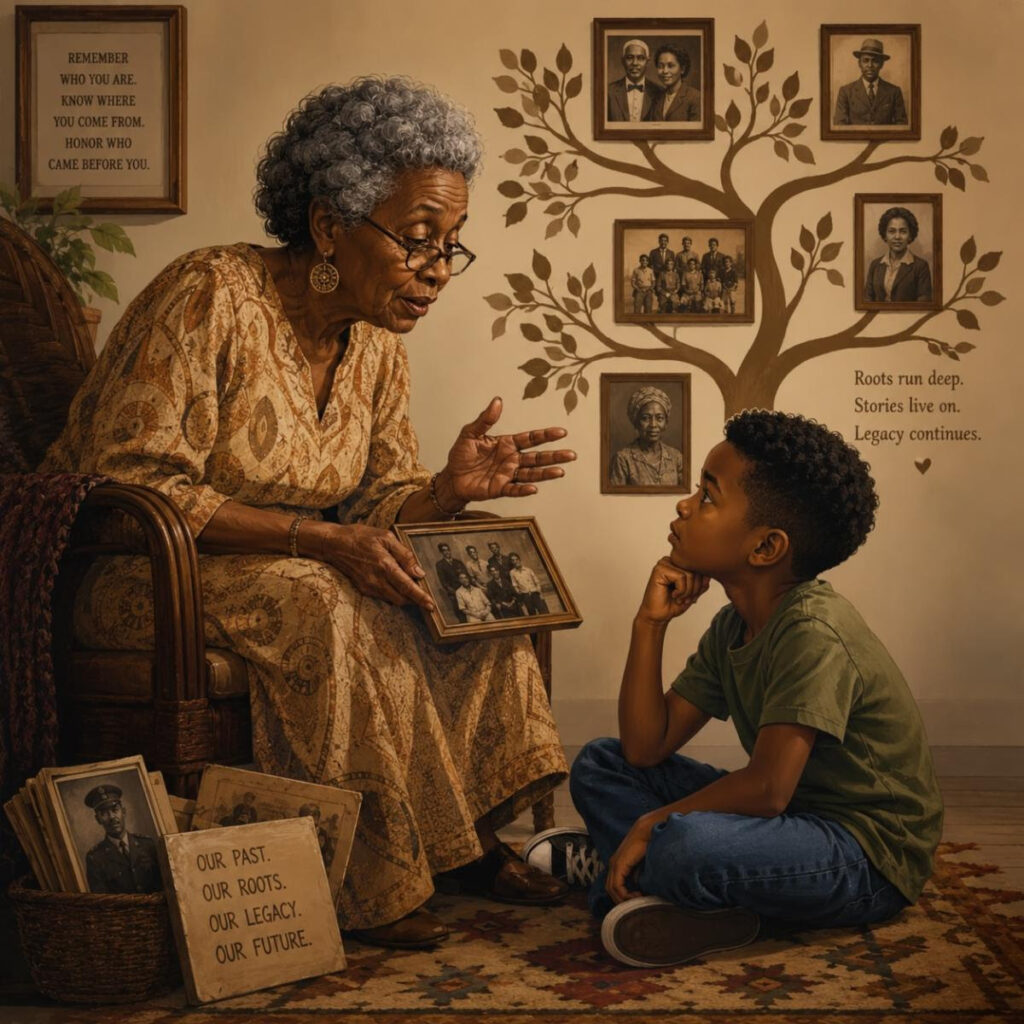
In 1865, many of the 31 million (11 million were from former Confederate states) citizens of the country were elated with this outcome. I am certain that every Black person was overjoyed. And two of them were my maternal ancestors, Richard and Susan Duty. Knowing their names makes the Juneteenth holiday quite personal for me.
The catalyst for my discovery of these relatives came from an 86-year-old retired registered nurse, Lottie Robinson. My mother’s younger sister, Aunt Lottie, has always been a great storyteller with an outstanding memory. A few years ago, she told me the story about my family, almost nine decades ago, moving from Alexandria Rapides, Louisiana, to Chicago.
Enthralled, motionless and beaming with pride, I listened to her recitation of how my grandfather, James Grant (who was respectfully called “Mr. Grant,” “Jimmie Grant” and even “granddaddy” by nonfamily members when I was a kid), hopped on a freight train in Louisiana in 1938 and rode it all the way up to Chicago. Shortly after arriving in Chicago, he found employment at a steel mill as a mechanic, where he worked until retiring 40 years later.

For almost a year, he sent most of his earnings to my grandmother, Augusta Grant, who remained in Louisiana with their five children, including my mother, Ollie Mae. She was the oldest daughter, and as is tradition with Black Southern families, she was referred to by her parents, siblings, neighbors and friends as “Sister.” This prestigious moniker was shortened by some to “Sis.” And while my mother’s siblings called their mother “Ma,” my mother always called her “M’Dear,” which was short for Mother Dear.
A year after my grandfather arrived, my grandmother moved to Chicago with her children. But not all five! Lottie, the youngest, stayed behind to live for several months with my grandfather’s sister and her husband, who had no children. To this day, my Aunt Lottie speaks of them with great admiration and refers lovingly to them as Aunt Suzie and Uncle Son.
She also had a great, detailed memory of them taking her to the station to board the Illinois Central Railroad train bound for Chicago. For many Black Southerners, Chicago was called “the promised land!” The lure of the city, combined with the desire to leave the South, resulted in the Chicago migration of over half a million Black people from Louisiana, Tennessee and Mississippi.
Aunt Lottie remembered seeing Uncle Son give money to the Pullman porter, Mr. Jones, on the train, so that he could watch and care for her on the 15-hour journey (in the white sections of the train, the passengers called the Pullman porters “George”).
She fondly remembered, with periodic giggles, sitting in the front seat of the train’s “colored section,” happily looking out the big side windows, with her feet dangling in the air and one hand closely holding the paper bag on her lap filled with food by Aunt Suzie. She seemed tickled by the memory that her hair was braided and tied up with a flowing red ribbon, and she wore a pretty pink dress, with white socks and shiny black patent leather shoes. And when the train pulled into the Chicago station, she said she was overcome with joy as she saw waiting for her “my daddy! Jimmie Grant!” When the train stopped, my grandfather jumped on the train and ran inside and scooped up my aunt in his arms, as he kissed her on her cheeks and gave her a big playful “Zerbert,” making funny sounds with his lips, which involuntarily elicited overt laughter from my aunt. He drove her home to their big apartment at 25 E. 116th St. in the Roseland neighborhood.
Ten years later, they were the first Black family to buy a house in their block in the Englewood neighborhood. They purchased it ”on contract” from a white owner, at an interest rate of 16%, which was significantly higher than mortgage interest rates provided by banks. This was due to their inability to get a bank mortgage because of government-mandated “redlining policies,” whereby banks were forbidden from providing mortgages to “Negroes” because the federal government would not guarantee the loan as they did for whites and other ethnic groups. Years later, my grandparents finally got a mortgage with a significantly lower interest rate of 5% from Sears, Roebuck and Co.
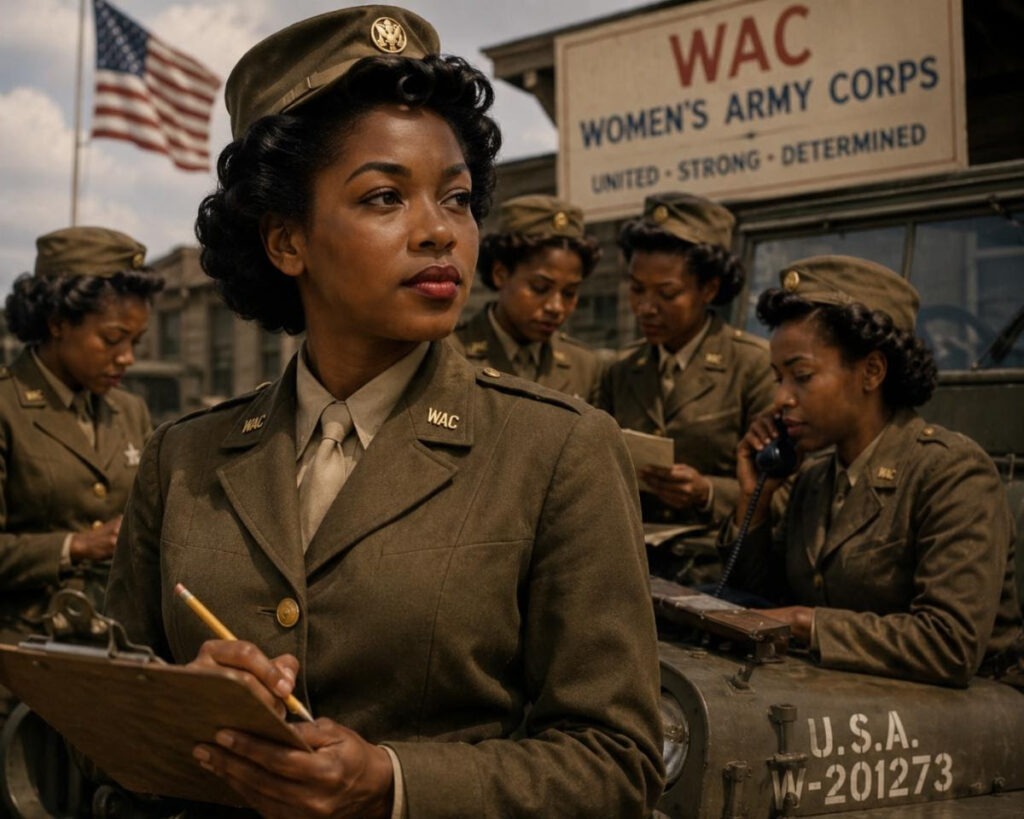
Over time, Aunt Lottie told me numerous other stories, but with fewer details. A particular instance of note is when we were talking about my uncle, brother and other family members who served in the U.S. military. And she stated very proudly, “Your great aunt, my daddy’s sister, was a WAC!” She said no more. Conducting some follow-up research of my own, I learned that this great aunt was 1 of 6,500 Black American women among the 140,000 women who served honorably in the Women’s Army Corps during WWII. Her commitment and allegiance to America were the same as millions of other Black veterans who have served valiantly in every American war in history, beginning with the Revolutionary War. No other race or ethnic group of U.S. citizens has served in more.
The word Juneteenth is a portmanteau, like the word chatbot, which is regularly used today when discussing generative artificial intelligence. Both are new words created by blending two words together. The latter is derived from the words “chatter” and “robot.” The former comes from the words June and nineteenth, the date in 1865 when millions of Black people gained their freedom.
While my aunt did not know the particular impact of that date on our family, she shared a simple sentence with me that led to the discovery of our ancestors born into slavery in the first two decades of the 19th century. One day, she calmly said to me, “Remember an elder in our family once saying we have people who owned a little town in Louisiana.” That led to the identification of my great- great-great-grandparents Richard and Susan Duty. Richard was born in 1824 in Louisiana, and Susan (nicknamed Sookie) was born in 1823 in Kentucky. Her maiden surname was Madden.
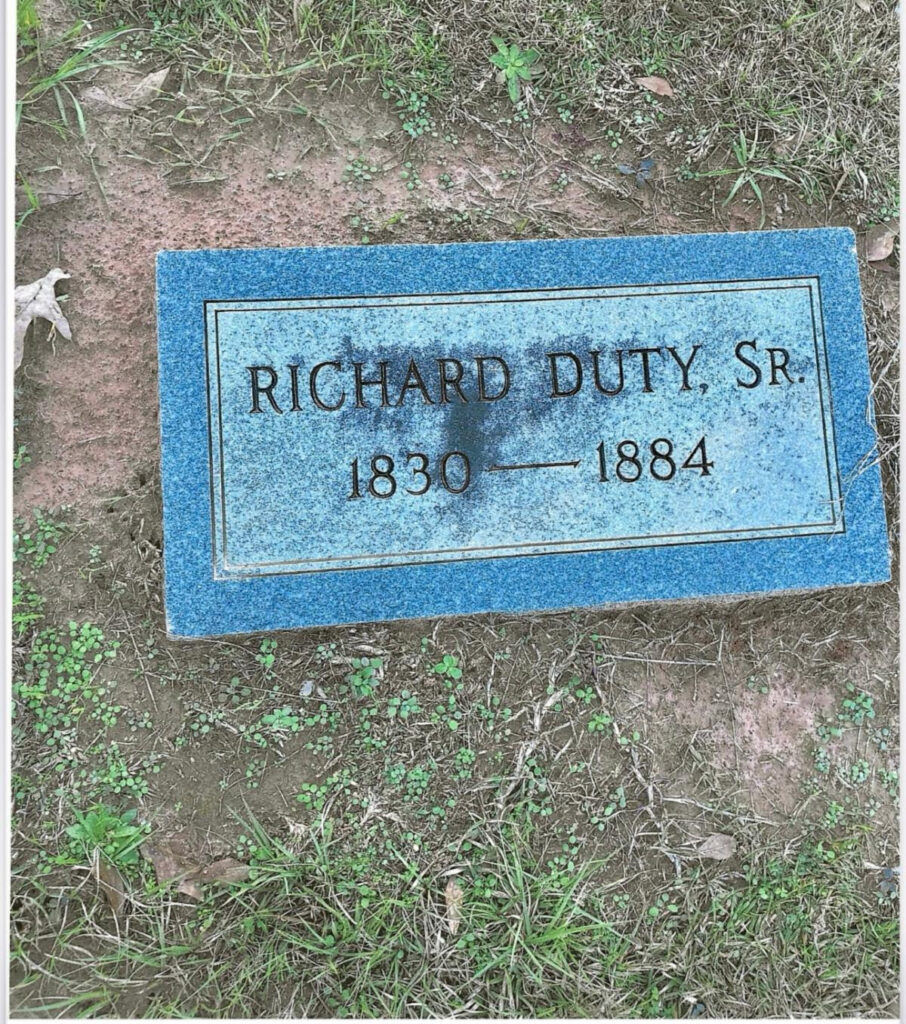
All of this information was unearthed when my daughter, Ariel (an ETHS alum), gave me a Father’s Day gift of the services of Christopher Smother. She hired him to research our family’s lineage for as far back as he could. And he did an outstanding job of identifying our ancestors, going back over 200 years.
Christopher is a brilliant genealogist who owns the company Unearthing Your Roots Inc., located in Louisiana. As a devoted son of the state, when he heard the new pope had ancestors from New Orleans, he worked with another genealogist and discovered more about Pope Leo XIV’s Black heritage.
In addition to making this wonderful discovery, through his meticulous research, Christopher also gave greater life to Aunt Lottie’s declaration about the contributions of our family to a small predominantly Black town. It was in Bienville Parish, Louisiana, where Richard and Susan settled following the ratification of the 13th Amendment in December 1865. The amendment abolished slavery in all 31 states of the country, not just the 11 former Confederate states where the Emancipation Proclamation was applied. Therefore, this fact shows that for six months, from the date of Juneteenth to the ratification of the 13th Amendment, slavery still existed in the United States.
But after they were emancipated from enslavement, Richard and Susan became entrepreneurs, worked extremely hard, got lucky, saved money, made investments and with the grace of God became great assets to the Black community as generous, selfless philanthropists. From the History of Bienville Parish. United States: Bienville Parish Historical Society, I learned that:
“Richard was Methodist by religious faith, and Susan was Baptist. They gave land and built the first C.M.E. church called St. Duty. They also bought land and built the first Black Baptist church in Arcadia. They gave land and built the first school for Black boys and girls in Arcadia. They also gave land for the St. Duty cemetery where many Blacks throughout the area were buried, including Susan, who died in 1871, and Richard, who died in 1884, leaving more than 700 acres of land, houses, and livestock.”

Becoming aware of this fascinating information made me swell with pride! But it also made me sad knowing that these wonderful people had been enslaved. It’s a similar bittersweet feeling that I get on the Juneteenth holiday, which is a day of ancestral mourning and a day of celebration.
I experienced the same paradoxical feelings when I called my aunt with the joyful news that she was correct. We did have people who were major contributors to the health and development of a small town. After I shared the good news with her, she told me that she was recently diagnosed with Lewy Body Dementia. I silently cried. It was so sad to hear that news about a special woman gifted with a brilliant mind.
So, as we celebrate Juneteenth today, I encourage all of you to identify and talk to the Aunt Lotties in your family. And I strongly believe this for Blacks whose ancestors date back multiple generations in America. I am certain that your ancestral journey will lead you to formerly enslaved people like Richard and Susan Duty, who must be honored on Juneteenth, and every day of the year, as an American Hero and She-ro!
Steven Rogers is a retired professor from Harvard Business School and Kellogg School of Business. He has lived in Evanston over 40 years. His daughters attended King Lab and Evanston Township High School.