
The first observance of “Decoration Day” took place in 1865 in Charleston, S. C., and was initiated by formerly enslaved Africans, three years before General Logan’s action. General John A. Logan‘s proclamation was issued in 1868.
After Civil War battles, remains were often placed in mass graves. This 1863 photograph from the National Archives shows one of the unusual instances when coffins and individual graves were prepared following the December 1862 Battle of Fredericksburg. Memorial Day began weeks after the Civil War ended in 1865, when thousands of freed slaves risked their lives to properly establish a cemetery in South Carolina.
Monday, May 25, millions of Americans enjoy the company of family and friends in remembrance of the sacrifices men and women made in the name of our freedom. Originally coined Decoration Day, the observance is a U.S. federal holiday and is a time to pay tribute, especially by decorating the graves of those whose lives were lost in military service. This time of year, Americans often see news photos of volunteers moving through Arlington Cemetery in Washington, D.C., for example, decorating the long rows of graves.
This tradition actually began weeks after the Civil War ended—but this real story of Memorial Day is only now coming to light.
Real Story of Our “First” Memorial Day
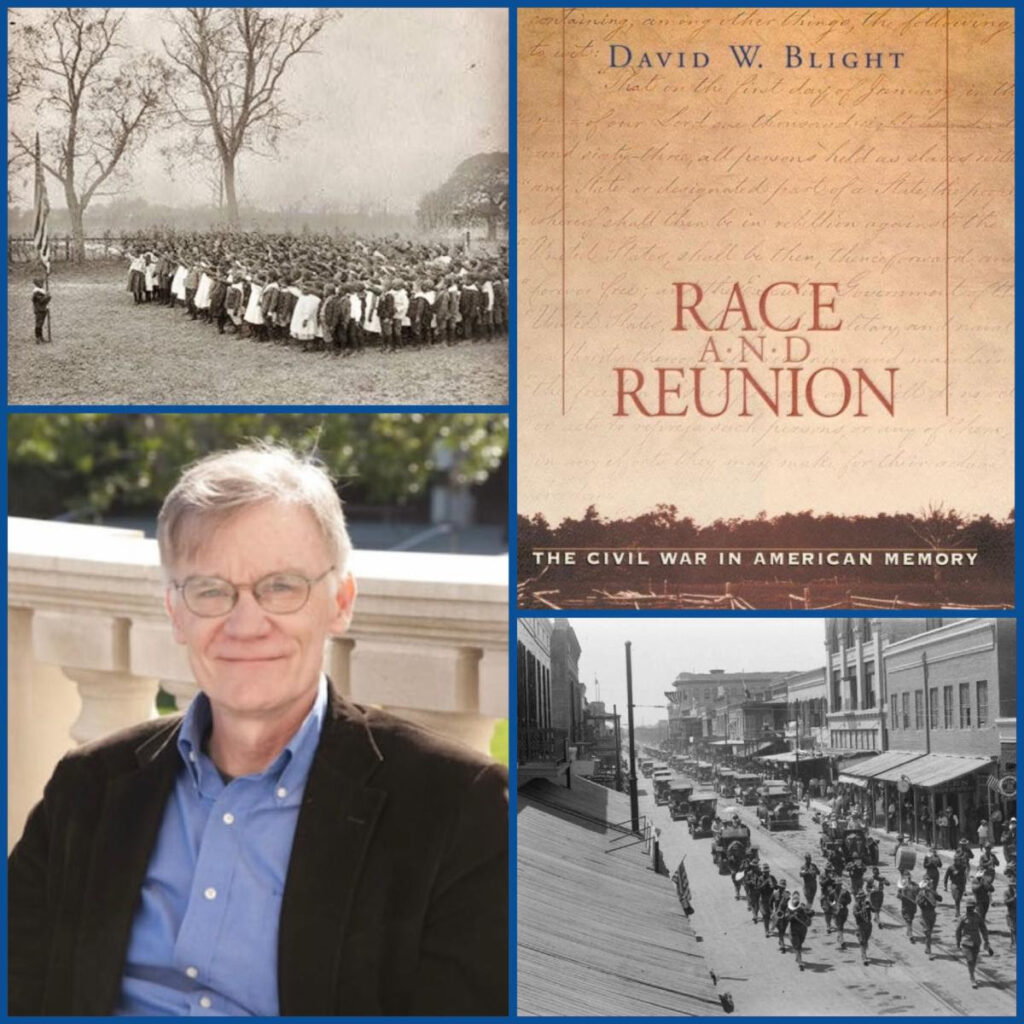
Here’s why it’s important to remember—and spread the word—about the real story of Memorial Day. Yale University historian David W. Blight undertook the groundbreaking research that is changing the way this milestone is understood. He published his findings in a 2002 history, “Race and Reunion.” Even the History Channel’s “History of Memorial Day” video ignores the stirring 1865 chapter of U.S. history that Blight finally uncovered. (Over time, scholars expect that our collective “history” will be restored to include the 1865 event.
The first Memorial Day was marked by former slaves in Charleston, South Carolina, who created proper, individual graves for fallen Union soldiers who had been buried en masse near a Confederate prison camp. For most of the 20th century, however, the “first” Decoration or Memorial Day was credited to Waterloo, New York, mainly because the freed slaves of Charleston, South Carolina, didn’t have the connective clout enjoyed by the men promoting Waterloo’s ceremonies. News of the Charleston effort never spread across the U.S. and eventually vanished from our national memory. Of course, the Waterloo effort was noble, too, but its claim to be our “first” must now be qualified as perhaps a “first in the North.”

According to Blight’s research, on May 1, 1865, 10,000 former slaves gathered at the cemetery site they had rebuilt and elaborately decorated in Charleston, South Carolina. Their courage is inspiring because they were making a large-scale public demonstration of their love and respect for fallen Union soldiers—within weeks of the end of the war. Their brave actions easily could have brought their families into harm’s way from white neighbors who still strongly supported the defeated Confederacy.
Preparing for that first Memorial Day was an expensive, back-breaking effort in which a proper cemetery actually was built from the ground up by African-American volunteers before May 1. On a spiritual level, these freed slaves were intent on starting their new lives by literally digging up and reshaping a key part of their past. The site of this first Memorial Day, once a local race course, had been a Confederate prison camp where Union soldiers’ bodies were heaped in a mass grave. Volunteers prepared for May 1, 1865, by digging up the discarded remains, burying them properly, adding a wall around the cemetery, plus a proper arched entryway for visitors. Today, the site is Hampton Park. If you know Charleston, you’ll realize there is no Civil War cemetery there now.
Eventually, these remains were moved again to a new U.S. national cemetery in Georgia.
The words “Memorial Day” were first used in 1882, although Memorial Day was not officially declared in federal law until 1967.
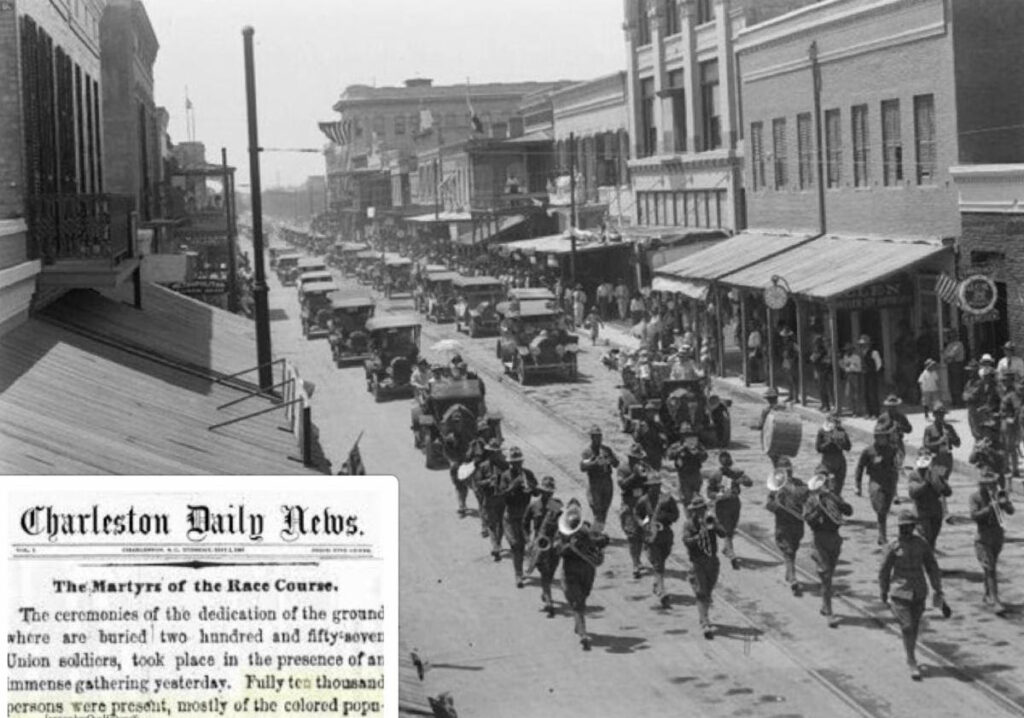
IMPORTANT IN THE RESEARCH of Yale historian David W. Blight were newspapers from the 1860s. The following story comes from the Charleston Daily Courier, a popular daily in South Carolina at the time. (It later merged in 1873 with another newspaper.) In its heyday, the Daily Courier had a reputation for innovation and diversity, perhaps partly because it was founded by a Northerner in 1803, Aaron Smith Willington, a newspaperman from Massachusetts. The newspaper carried overseas news, gathered by staffers who rowed out to meet arriving ships. The staff also included a Spanish translator to cover news from Cuba, Mexico and South America.
In May 1865, the newspaper covered the nation’s first Decoration or Memorial Day observance, held on May 1, 1865.
Here is the Daily Courier coverage of that first Memorial Day, May 1, 1865. Original 1865 headline: “The Martyrs of the Race Course”
CHARLESTON, South Carolina—The ceremonies of the dedication of the ground where are buried two hundred and fifty-seven Union soldiers took place in the presence of an immense gathering yesterday. Fully ten thousand persons were present, mostly of the colored population.
The ground had been previously laid out, the mounds of the graves newly raised, and a fine substantial fence erected around the enclosure by twenty-four colored men, “Friends of the Martyrs,” and members of the “Patriotic Association of Colored Men.” The exercises on the ground commenced with reading a psalm and singing a hymn and were followed by a prayer. The procession was formed shortly after nine o’clock and made a beautiful appearance, nearly everyone present bearing a handsome bouquet of flowers. The colored children, about twenty-eight hundred in number, marched first over the burial ground, strewing the graves with their flowers as they passed.
After the children came the “Patriotic Association of Colored Men,” an association formed for the purpose of assisting in the distribution of the Freedmen’s supplies. These numbered about one hundred members. “The Mutual Aid Society,” an association formed for the purpose of burying poor colored people, about two hundred strong, followed next. These were followed by the citizens generally, nearly all with bouquets, which were also laid upon the graves. While standing around the graves, the school children sang “The Star-Spangled Banner,” “America”, and “Rally Round the Flag,” and while marching, “John Brown’s Body.” The graves at the close of the procession had all the appearance of a mass of roses. Among those present at the speaker’s stand inside the enclosure were General Hartwell, Colonel Gurney, Colonel Beecher, Rev. Mr. Lowe, Mr. James Redpath and others, about thirty in all.
During the exercises, General Hartwell’s brigade, consisting of the 54th Massachusetts, 104th and 85th colored regiments, appeared on the ground and was reviewed by General Hartwell. They marched four abreast around the graves and afterwards went through all the evolutions of the manual.
Outside and behind the Race Course, a picnic party was present with refreshments. The crowds dispersed and returned to their homes about dusk.