
A Night of Cultural Power: The Critics Choice Celebration of Black Cinema & Television
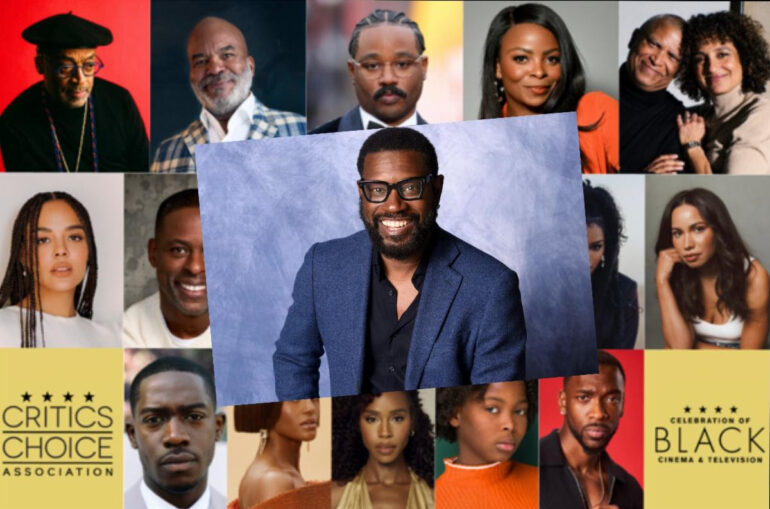
The Critics Choice Celebration of Black Cinema and Television has become an industry favorite for many of Hollywood’s Black film community. More than an awards show, it is an opportunity to build community, champion great filmmaking, and celebrate some of the industry’s greats. Executive Producer, Shawn Edwards guides us through this year’s exciting event, helping us highlight several of this year’s nominees and our discussion with each of them about their projects.
The event’s genesis traces back to a pivotal moment in film history. As Edwards recounts, the idea was ignited by a remarkable year for Black film: “Initially it was just a celebration of Black Cinema. 2013 was a banner year for movies being released about the Black experience. When I say banner year, I mean there were like three or four movies, and we got really excited. So I took that excitement and ran to the head of the Critics Choice Association and said, in some kind of way, we should celebrate this because this has never happened before.”
Edwards sets the tone for the event’s significance: “It’s truly an honor to continue our tradition of celebrating excellence in Black cinema and television. This has been a banner year where Spike Lee — the godfather of contemporary cinema — continued to inspire with his groundbreaking vision; Ryan Coogler represented the next generation of visionary filmmakers reshaping the culture with Sinners, and a record number of Black women created unprecedented impact with a wide range of diverse and high-profile roles.”
Now in its 8th year, the Celebration honors those who have shaped the culture. This year’s event, taking place in Los Angeles on Tuesday, December 9, 2025, spotlights a dynamic range of legends and rising stars.
The Cinematic Godfather: Spike Lee
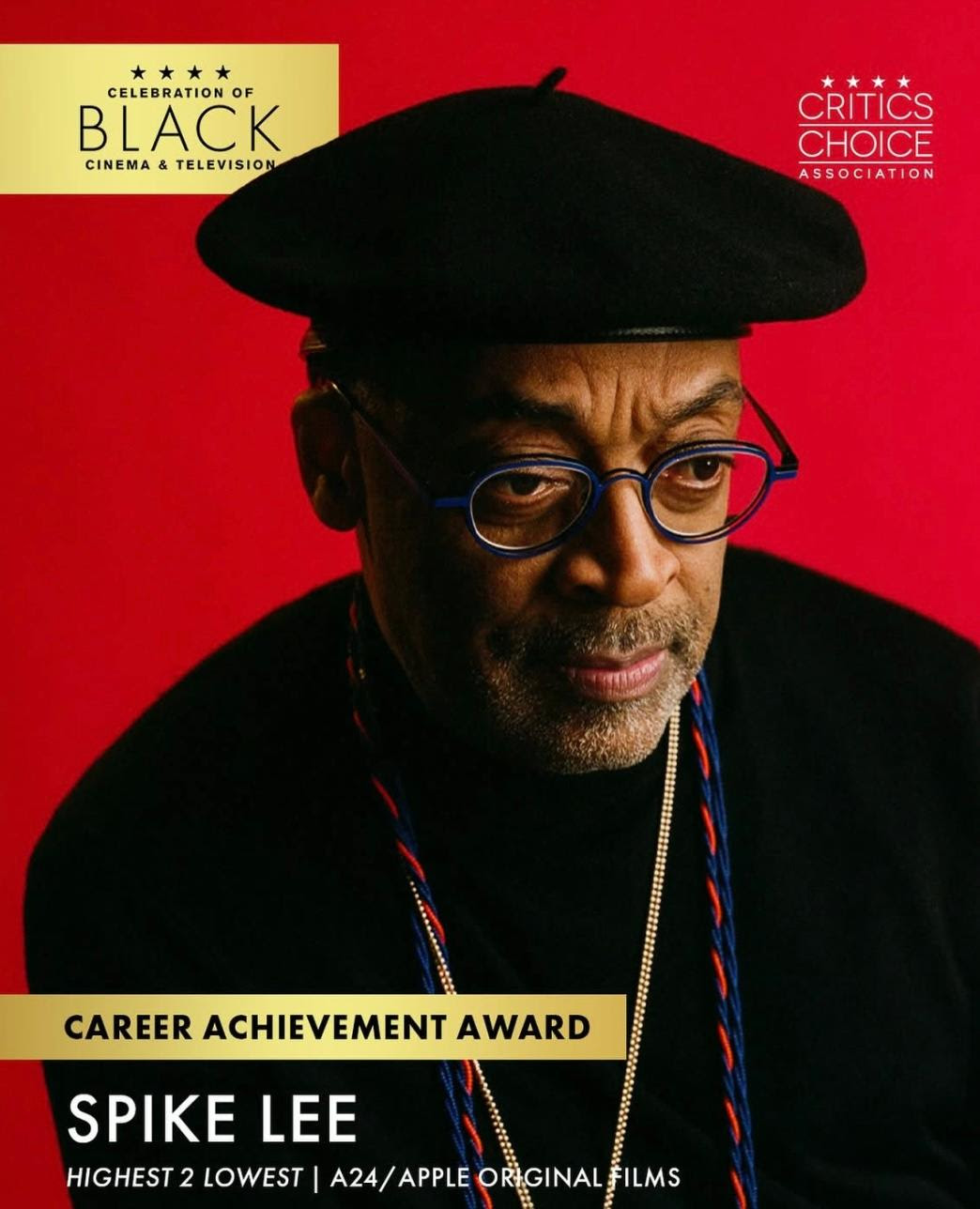
Receiving the Career Achievement Award, Academy Award-winning writer-director Spike Lee is recognized as a monumental figure whose work inspired generations.

Edwards spoke passionately about Lee’s indelible mark on the industry:
“Number one, the room is gonna be filled with more than 500 people, and none of those people would be in that room that night if it weren’t for Spike Lee. Spike Lee is the godfather of contemporary Black cinema. There, there’s no debate. There’s no argument, done! He’s the one who either ignited people’s passion into making films, inspired people to make films, or got people to watch films at a different level.”
Lee offered insight into the moment his path to filmmaking began in college: “It was the fall semester of my junior year. I chose a major, and it was Mass Communications. Morehouse didn’t have that major, but that major was across the street at Clark College, now Clark Atlanta University. At the time, mass communications were film, TV, radio, and journalism, and that’s where it started. I decided I was going to give filmmaking a shot. So after I graduated from Morehouse, I still wanted to get more education. So I applied to three grad film schools. I applied to AFI, but did not get in. I applied to USC, but I did not get in. To get into those two schools, you had to get, take the GRE. Standardized testing, and it’s been proven that those tests are biased. But luckily for me, thank God, you didn’t have to take a standardized test to get into NYU Graduate Film School. And I got in, and that was it.”
Lee, who famously loves sports, pondered the role he plays in the creative process, beginning in one place but ending somewhere different altogether: ”I’m the owner. I’m not the owner. That’s not my money. I’m the general manager, scout, manager, psychiatrist, all of that.”
When asked if he eyed retirement, given his long-time collaborator Denzel Washington has declared retirement from the craft is quickly approaching, Spike revealed both his skepticism in Washington’s comments and his own desire to keep on moving forward in the filmmaking world: ”Denzel, after he said he was retiring, signed for four more films. He fooled me. So, because I thought he was retiring, I was saying that this film was gonna be our last film together, but I’m not saying that now. I have a lot to do.”
The Dynamic Duo: Ryan Coogler & Michael B. Jordan
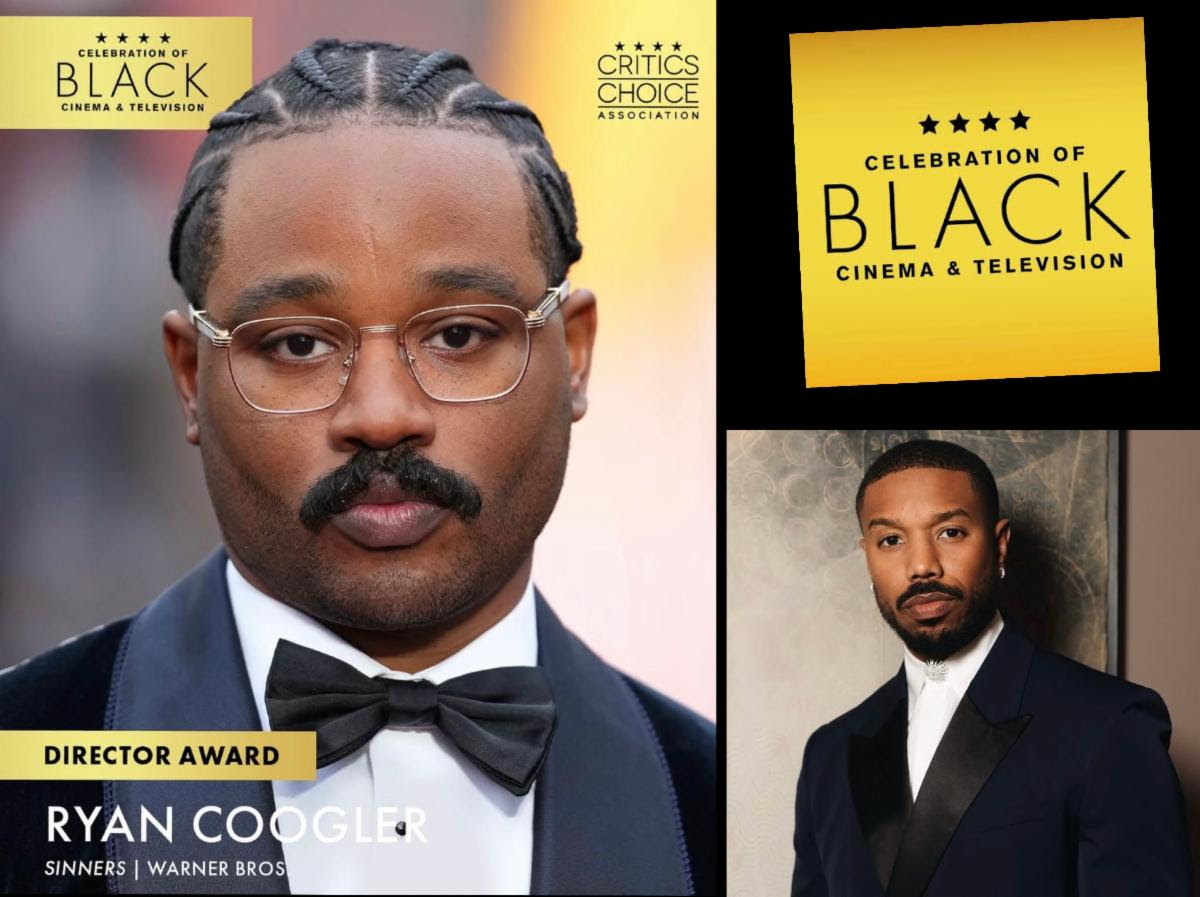
Visionary filmmaker Ryan Coogler receives the Director Award for his cinematic achievement, Sinners. Edwards praised Coogler’s unmatched box office record:
“Ryan Coogler is baby Spike. Ryan is the contemporary equivalent of Spike Lee, except Ryan is the master of the box office. Ryan may be the only major director in Hollywood who’s batting a thousand: Fruitvale Station, both Creed movies, both Black Panther movies, and Sinners. He’s batting a thousand.”
Coogler and his frequent collaborator, Michael B. Jordan, who starred in Sinners as the twin brothers Smoke and Stack, discussed the complex moral landscape of the film. Coogler explained his writing approach, focusing on how the twins view themselves:
“As a writer, I never spent time judging these characters… what excites me the most about the twins is that they self-identified as bad guys. That was how they kind of moved through the world. That was how they saw themselves. That was how they talked about themselves. And that was fascinating because I had never worked with characters that would look you in your eyes and tell you straight up, “I’m a gangster. I’m gonna kill you. I’m a pimp,” and make no apologies about that. And yet and still show the humanity that exists inside of them, showing that even their own way of self-identifying isn’t totally true.”
Jordan elaborated on how the twins leveraged this self-identification:
”They used that as an advantage during the times because if people feared them, they could get what they wanted… So they did that, they definitely leaned into the fear mongering of it all.”
Both Coogler and Jordan were quick to point out how the women of the film were critical to the foundation of the story: “Using that great James Brown lyric (referring to “This is a man’s world but it wouldn’t be nothing, nothing without a woman or a girl”), it is all over the blues music. You have women making contributions like Geeshie Wiley with Pick Poor Robin Clean or Last Kind Words. But even in what you would think was a male-dominated genre, the Delta Blues, all the songs were about women. Like all of them. We pulled the characters’ names from these songs. You got the great Son House, who made the song Pearline. That was where we got the character Pearl’s name from, and you kind of get a sense of the dynamic that’s existing.”
Jordan also powerfully described the essential, foundational role of women in the world of Sinners: ”Yeah, man. The foundation of those relationships …without Annie, and her wisdom, her spiritual prowess, her emotional intelligence, and leadership. I mean, the movie kicks off with her narration, you know what I’m saying? Her voiceover is setting the tone of what we’re contextualizing. When shit goes down, everybody somehow looks to Annie, asking, “What the hell are you talking about again? What’s going on?” In most households that I’ve been in and raised around, there are numbers of strong, smart, intelligent women who are making sure things are really running the way it needs to run, rather than get the full credit for it.”
The Chameleon and the Culturally Gutsy Director: Tessa Thompson and Nia DaCosta
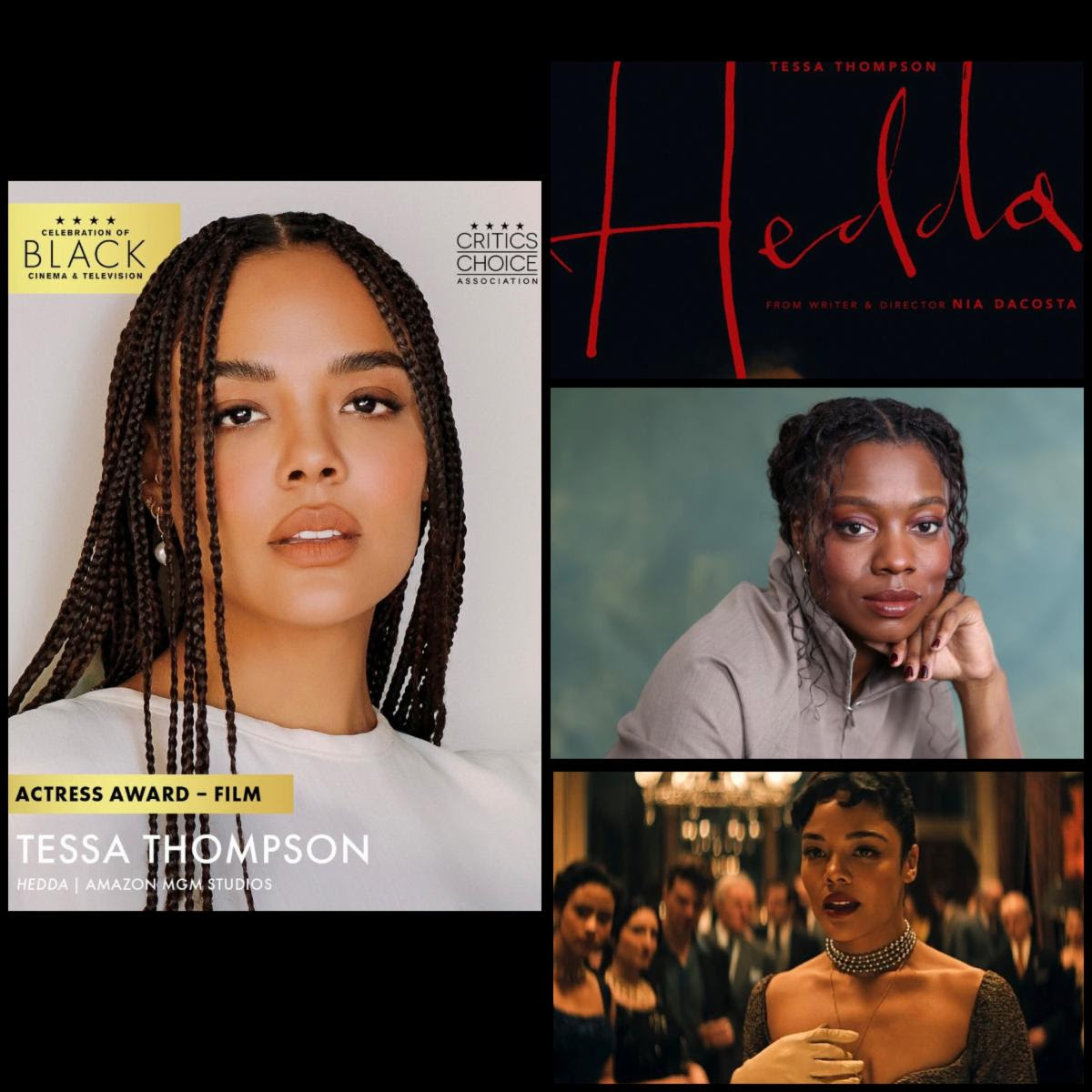
Tessa Thompson is honoured with the Actress Award (Film) for her mesmerising performance as the titular iconic feminist in Hedda by director Nia DaCosta.
Edwards praised Thompson’s versatility, noting, “Tessa is a chameleon. And that’s a compliment. Tessa has this ability to just absorb herself into every role she does… You’ve never seen the same Tessa twice.”
Thompson spoke about the intensive research process for a classic, iconic role like Hedda Gabler: “I love, love, love the process of research. I love what I learn about different time periods, different cultural attitudes, different perceptions, and also what I learned about myself. And then this role is such an iconic role, and so many incredible performers have played her, and people know that and have a relationship with it. There was so much noise in my head because Hedda is also just a noisy presence, and I needed to quiet the noise by engaging headfirst with watching these productions. I’ve gone to the archives just in my free time to watch productions. I got to just scratch that itch, and hope it doesn’t make me more terrified, or that someone’s performance doesn’t get tattooed on my brain. But I think the truth is that for what I do, you’re always taking in so much, and you have to trust that it’s all being funnelled through you. How brilliant it is that we get to tell these stories, we get to knock them around for centuries. We get to still debate and argue about these pieces of work, and we get to hopefully, if you’re lucky enough, get to take them apart and repurpose them and put them back together in your own image.”
Thompson’s director, Nia DaCosta, was lauded by Edwards for her courageous adaptation: “I look, what Nia, what Nia DaCosta did was so gutsy. And how she just flipped the script with that story and added all those new elements to punch it up, make it more relevant, and make it more contemporary.”
DaCosta explained the core challenge and draw of the character and story:
“I really thought it was interesting how she (Hedda) really challenged people to think about freedom and bravery and cowardice and power and how we attained those things, how we lived those things. Also, she was really funny, and she was really kooky, but she was really vulnerable.” DaCosta also noted her approach to character vulnerability: “I wanted everyone’s vulnerabilities to be really clear. Even if we didn’t understand the font of the pain, I wanted it to be clear that they were in pain.” Specifically on her choice to change a character’s gender, she said: “I thought about him a lot, and I was like, ‘Man, I feel like these struggles would make more sense if they were women’s struggles.’ “I’m so brilliant, but no one will listen to me.” “I am actually a genius, and it pains me that no one sees me or no one will listen.” And I was like, ‘Oh, of course that would drive a woman to depression and then to drink.’
The Cinematic Around the Way Girl: Teyana Taylor
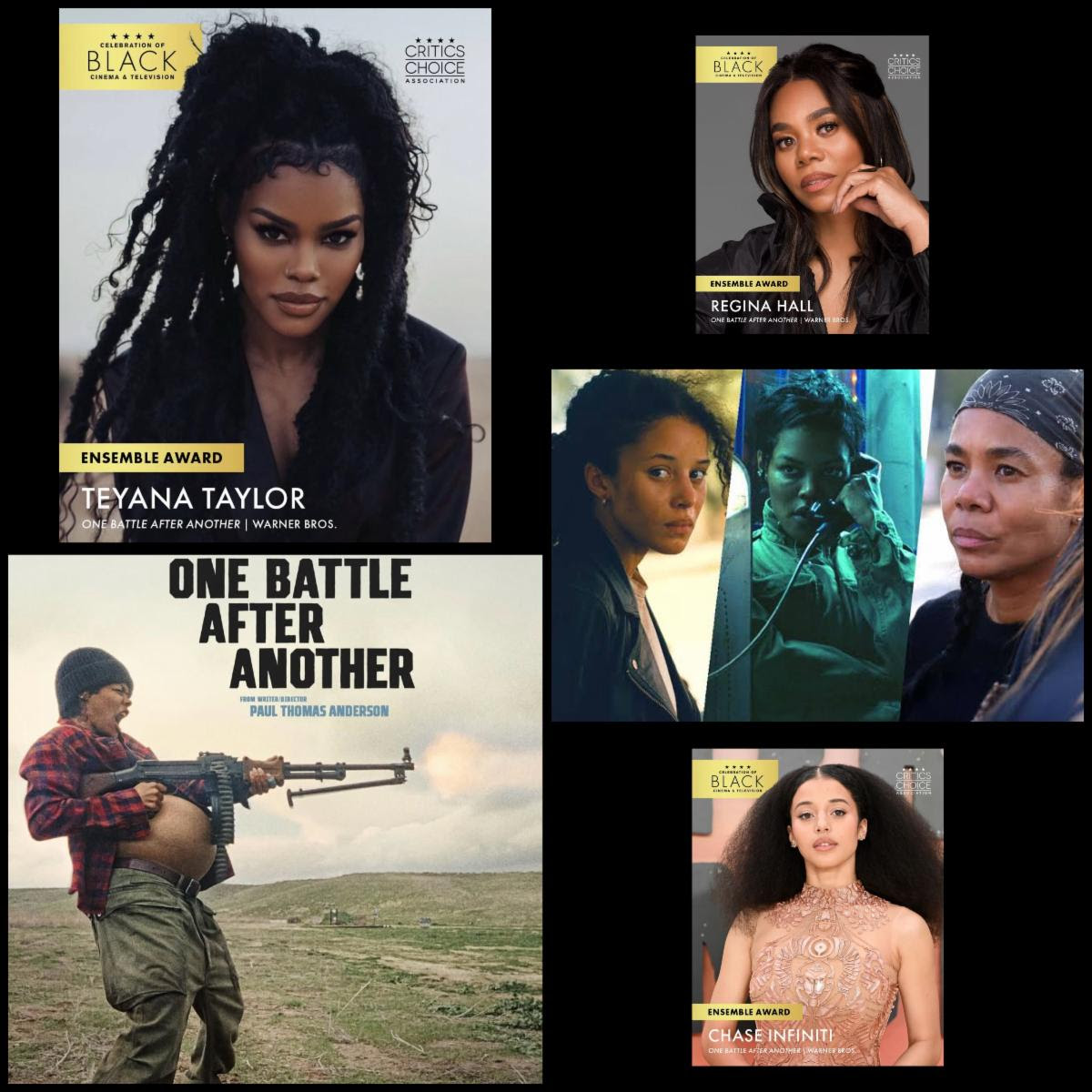
The cast of the action-comedy One Battle After Another—Regina Hall, Teyana Taylor, and Chase Infiniti—will receive the Ensemble Award.
Edwards described Teyana’s unique flavor on screen: “I love Teyana and everything she’s in because she’s an enigma. I’ve never really seen anybody like her on screen. She could be sophisticated, but she’s kind of got like a little bit of a hood swagger that works. It’s like I know this woman. Like when it’s time to go out, she’s cool as hell, but you might also run into her at the laundromat. She’s got that flava – you could see her driving a Benz, or you could see her catching the bus. She’s our cinematic around-the-way girl. She got that vibe.”
Taylor spoke compellingly about the need for honest, flawed portrayals of women, especially regarding the topic of postpartum depression:
“I think that Perfidia is so complex, and the humanity in it is what made us feel for her. Like, ‘Damn, she dead ass wrong, but why do I find myself feeling bad for her?’ I feel like Perfidia is 100% human, and everybody fucks up. So it felt good to see her be human and see her be flawed. It probably hit harder for other women who are mothers because, you know, a lot of that behavior came from postpartum depression as well. I think that’s what we also empathize with, because who are we to judge how a person handles their postpartum depression? It’s already something that is slightly ignored and not taken seriously. So imagine as a woman to not feel seen, heard, loved, and to also be fetishized, or be sexualized. Perfidia had been through some shit. ‘I got a gun in your head, and you’re calling me Sweet thing.’ So from the beginning, they’ve been playing in her face. I feel like Perfidia was robbed of so much, and she was put in these positions where she had no choice because she was selfish.”
She added that the flawed nature of her character was essential to the story’s meaning: “She’s supposed to fall for Willa to rise and be who she needs to be… that even that letter would not have been that letter if everything went the way we wanted it to go for Perfidia.”
Taylor also shared the specific challenge of a key scene: “My biggest personal battle, I’m not gonna front, was the scene where I had to walk away from baby Willa. That was very, very tough for me because again, I am in this character. But I would’ve handled my postpartum depression differently than Perfidia handled her postpartum. But everybody handled it in different ways.”
She also championed the presence of Black women across the film’s narrative: “I love that in this movie, you get to see every version of a Black woman. So even though you know Perfidia has shit, Ooh, she has shit, she’s such a hothead. But it felt good to see Deandra (Regina Hall) be the peace, she kept it all together. It felt good to see Willa (Chase Infiniti) hold it down for the new generation. It was a perfect balance. We were all who we needed to be in this movie to make this movie what it was. It was just so important for that representation to show that you can see a little bit of you in every single character.”
Clearly, the honorees are worth celebrating. Beyond each of them having a lot to say, there is power in bringing the community together to recognize the culture.
Don’t Miss the Celebration
Shawn Edwards‘ ultimate pitch for the Celebration of Black Cinema & Television centers on cultural resonance and being the awards show that truly recognizes Black achievements:
“The main reason people need to watch the Celebration of Black Cinema and Television is because I hear people complaining all the time, ‘The Oscars suck.” “They don’t understand our culture.” This is the show that does that. This is the show that is purposely designed to celebrate our culture. This is the show that loves the movies and the television shows that you love.
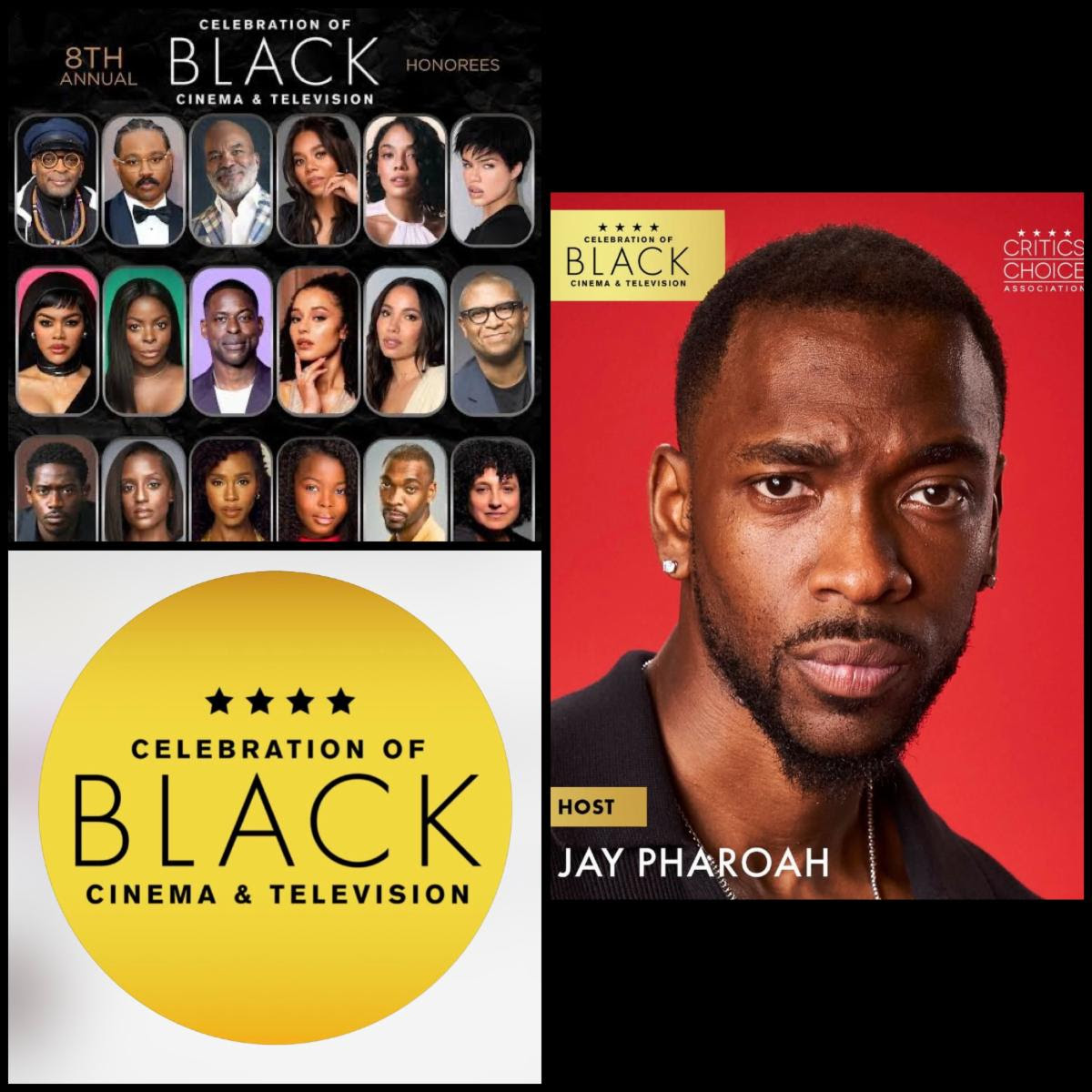
While we know you all can’t be in Los Angeles on December 9, this is just a glimpse of the discussions and celebrations that will be going on, and our Reggie Ponder will be there to report on it all. The awards show will feature a special musical performance and the return of last year’s host, Jay Pharoah.
Never fear! You will be able to experience all the excitement and celebration as it airs and streams exclusively on STARZ in early 2026.